


Lesia Ukrainka and The Forest Song: Myth, Love, and the Human Person

Updated: Sep 22
Published in honor of Lesia Ukrainka’s 155th birthday.

Lesia Ukrainka (the pen name of Larysa Kosach) stands among the great writers of Ukrainian literature. Alongside Taras Shevchenko and Ivan Franko, her work played a defining role in shaping the cultural and intellectual foundations of Ukrainian national identity. Drawing on classical literature, folklore, and myth, Ukrainka frequently reworked inherited narratives to invert perspective—particularly in her treatment of female characters—granting them agency, moral complexity, and interior life.
In her dramatic poem The Stone Host, Donna Anna is no passive object of desire but an active force who seduces Don Juan, overturning long-standing moral hierarchies. Likewise, in The Forest Song, Mavka—traditionally portrayed in folklore as a dangerous, seductive forest spirit—is reimagined as innocent, sensitive, and profoundly human. Through these reversals, Ukrainka reexamines long-standing moral and mythic hierarchies, inviting the reader to reconsider how virtue, strength, and the dignity of the human person are understood.
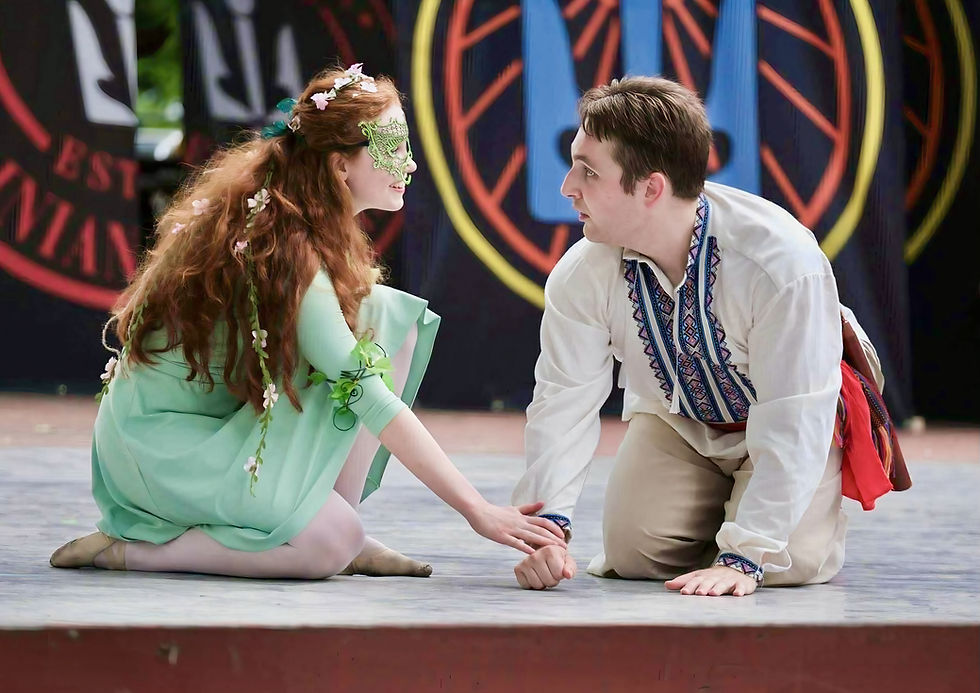
The Forest Song, widely regarded as her greatest masterpiece, draws deeply on Ukrainka’s childhood memories of the forests, legends, and oral traditions of her native regions of Polissia and Volyn. The drama centers on Mavka, a playful forest nymph, and her love for Lukash, a village youth whose music awakens her curiosity about the human world. Their bond is portrayed as a spiritual and emotional union: Mavka is drawn to the life-affirming beauty of Lukash’s flute-playing, while Lukash is inspired by her natural purity and freedom of spirit.
Set against Mavka is the widow Kylyna, her earthly foil. Kylyna is practical, capable, and socially adept—qualities that make her a successful wife within the norms of village life. Where Mavka is too sensitive to harvest grain, Kylyna performs the task with confidence and resolve. Ultimately, Lukash chooses Kylyna, submitting to social expectation and material necessity. Yet his choice comes at a cost: his heart never ceases to long for Mavka, and the loss of that transcendent connection haunts him long after the decision is made.

Through The Forest Song, Lesia Ukrainka offers not a simple moral lesson but a poetic meditation on love, freedom, and the cost of choosing order without wholeness. More than a century later, her vision remains strikingly modern—not because it rejects tradition, but because it understands that the deepest human truths are revealed through sacrifice, longing, and the quiet struggle to live in harmony with both conscience and calling.
For me, these truths do not remain only on the page. When I choreograph narrative work, I am deeply committed to giving each character a distinct physical identity — in gesture, rhythm, weight, and posture. I strive to craft for every role its own movement vocabulary and style, so that character is revealed not only through story, but through the body itself.
This is one of the reasons I am especially drawn to Lesia Ukrainka’s writing. She reshapes traditional archetypes, allowing figures who might otherwise feel familiar to breathe and emerge with surprising psychological depth and moral complexity. Just as her reimagining of mythic and literary types breathes new life into her texts, it opens expansive possibilities choreographically. Because her characters are imbued with their own fresh language, I am compelled to search for fresh physical languages that match. Her source material does not merely inspire adaptation — it provokes invention.
Comments